KS+A
002 Living Facade
Barcelona,2022
sustainability
The project will be developed as a refurbishment of the south-oriented façades on the two towers, which were built after the original complex, in the UB Faculty of Economic Science. Concrete grid pattern claddings on south facades of towers do not perform as functional elements in terms of ventilation, noise isolation, and sustainability. The project proposes to refurbish the existing façade of the towers and to fill the gap between two towers with ecological and organic material that is called “mycelium” which is attained from mushroom roots. Modular mycelium-based panels will be openable and fixed according to various necessities. Flexibility in design encourages dynamism and allows these to change by replying to the different angles of solar incidence and climatic variables.
mycelium
Since the manufacturing of materials is the main reason for the high level of carbon emission and energy consumption in the construction industry, it is an inevitable necessity to adapt ecological solutions during the production, construction, and deconstruction phases. Therefore, the proposal will explore the benefits of the refurbishment of existing facades, which are constructed with conventional materials, with sustainable and ecological alternatives. It is a fireproof material, resistant to mold and water, and that can reach a hardness greater than that of concrete at the same weight. Implementation of new mycelium-based panels will be made on the south-oriented surfaces of the adjacent towers (Tower 4 and Tower 6) of the UB Faculty of Economics & Science building. In order to have a continuous design, the void between the two towers will be covered with mycelium-based panels. The installation of vertical panels of Mycelium is made following a pattern in accordance with the existing modulation of the building. They are not fixed (not all of them) and rotate on a vertical pivot, which allows them to adjust their opening degree depending on the variable weather conditions of the seasons, and times of the day, among others, thus allowing them to naturally ventilate and illuminate the interior spaces. This new layer is anchored to the old concrete grid structure. This panel system is conceived to be an automated system that would be controlled with sensors and electronic devices.
deconstruction
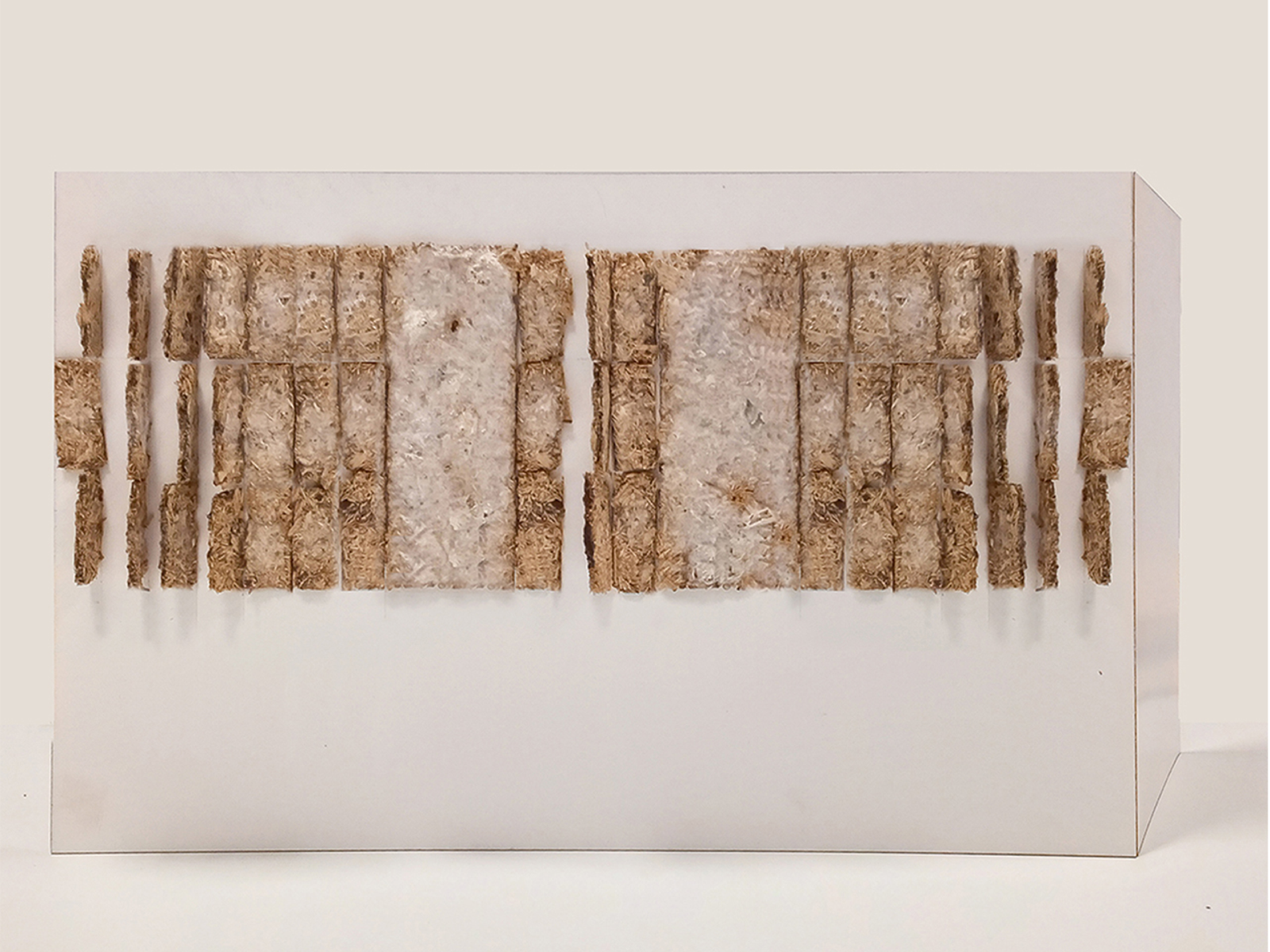
The project aims to find out a solution to the waste of construction materials after the demolition. Therefore, through the philosophy of “construction for deconstruction”, the production of mycelium panels has been tested through the small-scale prototype of the project. Mycelium panels grew within 5 days and their growing performance differs according to environmental conditions and their sizes. The sustainability of the mycelium façade proposal has been assessed in two different methods. Mycelium production and degradation process have been investigated and documented over 35 days. At the end of the investigation, it has been found that most of the mycelium has degraded within 30 days. During the production process of mycelium, prototypes have been tested in different environmental conditions. Mycelium panels degrade in the soil without creating any waste while biodegradation takes just months. On the other hand, conventional construction materials such as concrete and steel do not degrade in nature. Furthermore, mycelium panels use less energy, for the creation of moldings and the heating process, during production. Until the heating process, living panels capture carbon dioxide from the atmosphere.

Visuals & Drawings


Process


